
How to Pick a Therapist
What almost everyone gets wrong about therapy

When it comes to choosing a therapist, I’ve got good news and bad news. The good news is that you don’t have to worry about which therapy model your therapist is trained to use. That’s good news because there are over 400 published therapy models, and sorting through them would take valuable time and energy. And who has an excess of time and energy when they are feeling bad enough to be seeking a therapist? As you can see in the image below, the model or technique doesn’t contribute much to the outcome.
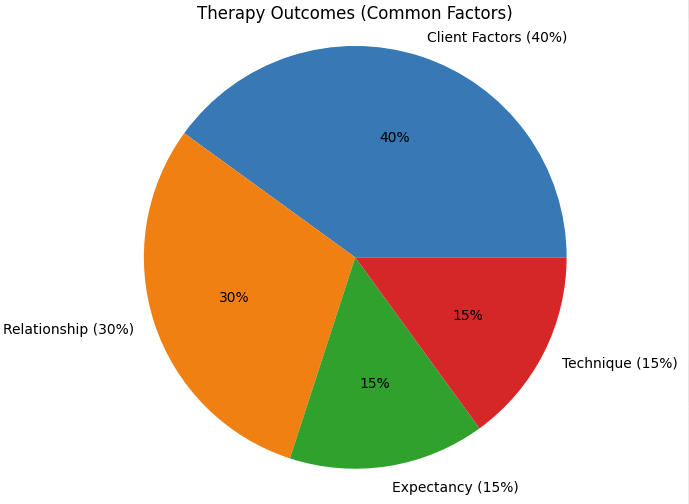
This estimate is the absolute upper end of all studies. Some studies have found that the therapist's model accounts for 5% or less of the outcome.
The previous 6 posts in this series delve deeper into why the therapy model doesn’t really matter. I won’t rehash that information here. But read them again if you need a refresher on why I say all therapy models work, and they work to pretty much the same degree.
So, that’s the good news.
The bad news is that the factors which really do matter—the relationship you and the therapist build together, and the sense of expectancy [the placebo effect] generated by therapy—are impossible to judge until you and a therapist actually begin to work together.
Unfortunately, most of us are flying blind into our first therapy session, just hoping we click with the person based on a recommendation and a few words and a picture on a website. Because of this, a first therapy session can be as unsettling as the first day of summer camp—no matter what the brochure says, or how many of your friends went there last year and loved it, there are a lot of unknowns.
To what, then, can I compare a therapist?
When I think about what advice I would give to someone looking for a good therapist, I can only offer analogies. The one that seems most helpful is the analogy to teaching.

The connection between teaching and therapy recently occurred to me when my pastor sent me a link to a framework designed to help people addicted to pornography. He suggested that I might glean some information that would be transferable to my field of work: chemical addiction. My pastor knows me well: my low-key oppositional defiant disorder, my snark, and skepticism of models. So, he rather wisely suggested I take a peek, or not, knowing that if he didn’t push, I’d be more likely to take a look.
The model that he pointed me to contained 3 phases. Each phase had several skills or kernels of knowledge that needed to be mastered as the person progressed from addiction to freedom from porn. My initial thought—usually my least charitable—was that at best this model was analogous to a teacher’s lesson plan—and a lesson plan, while necessary, is never the secret sauce that results in an extraordinary learning experience.
My second thought—also usually not very charitable—is that no one actually progresses in the kind of step-by-step, logical fashion proposed in this, or any other model. Instead, people leap forward, transform, and relapse in unpredictable ways.
In fact, watching people overcome any addictive behavior is sometimes like watching an overloaded plane bouncing along a runway until it finally launches into the air. Some people bottom out right before lift off. Some crash and burn because the runway is too short, or the load is too heavy. Others rise so gradually, I am not sure exactly when their wheels left the ground. But something clicks and sobriety begins.
Just the (therapy) facts, ma’am.
However, this does not mean there are no discernible patterns in therapy. Here are four universal patterns every person in the market for a therapist should know about.
One, if therapy is going to work, most people will feel marked improvement within the first three sessions. In fact, many people begin to feel better the moment they call a therapist. There seems to be something healthy about taking a step to get better. To mix my colloquialisms: Just as the journey of a thousand miles begins with a single step, getting to the point of setting an appointment is often half the battle.
Two, improvements will slow down, and there will be some diminishing returns after about 6 sessions.
Three, even though the pace of improvement slows down after 6 sessions, keep going. Most people leave therapy before they get the full benefit of therapy. If you are able, plan on taking a year or two to work on your issues.
Four, if something isn’t going right in therapy, tell your therapist.
That last point warrants some elaboration. I’ll start by telling you about a research study on hotel satisfaction that sheds light on why it is so important to tell your therapist about any dissatisfaction with your therapy. Researchers found that the hotels with the highest satisfaction ratings were not the ones that did the best job of meeting their clients’ needs. Instead, the hotels with the highest satisfaction ratings were hotels that disappointed their patrons in some way and then made it up to them. For example, if the hotel didn’t stock an important item and then made a point of purchasing the item, satisfaction skyrocketed
A similar dynamic has been found in research that closely monitors the therapeutic alliance during the course of therapy. Researchers found that the best outcomes didn’t occur when therapy was all smooth sailing. Instead, some of the best outcomes occurred when something went wrong with the therapeutic alliance and the therapist repaired the rupture. The place where a bone is broken sometimes heals stronger than the rest of the unbroken parts of the bone. Muscles that are stressed during weightlifting get stronger and more defined. And making up after a fight can be very rewarding for some couples.
The bottom line
If you feel I have given you no way to quantify what makes a good therapist, you are right. Before you begin working with them, there are very few ways to tell whether a therapist will be just great, just adequate, or just not right for you. So I would suggest treating your first couple of sessions as if you were auditing a college class. Here are a few questions you can ask yourself about the therapy in those initial sessions:
Does this person seem to understand my problem and propose a reasonable way out of my present challenges?
Am I more interested in getting better than before?
Do I feel more capable of getting better?
Do I feel respected and challenged at the same time?
Conclusion.
It can be very hard to choose a therapist because much of what you need to know can’t be discovered until you begin working together. The best analogy for therapy seems to be teaching. There are a few tried-and-true patterns that occur in most courses of therapy. And there are a few questions you can ask yourself early in the therapy process to determine whether you are on the right track.
P.S. If you are WELS Lutheran, you may have some unique concerns and questions about therapy. This page offers some very practical, well-written, and, in my opinion, extremely well-reasoned advice regarding therapy for WELS members. [No, I didn’t write it, but I know some of the people who did].
This post was a little too earnest and respectable for one of my typical posts, so to cleanse the palate, here is a little therapy humor from Bill Murray and the man who can get no respect.