
Let's Stop Teaching Maslow's Hierarchy of Needs

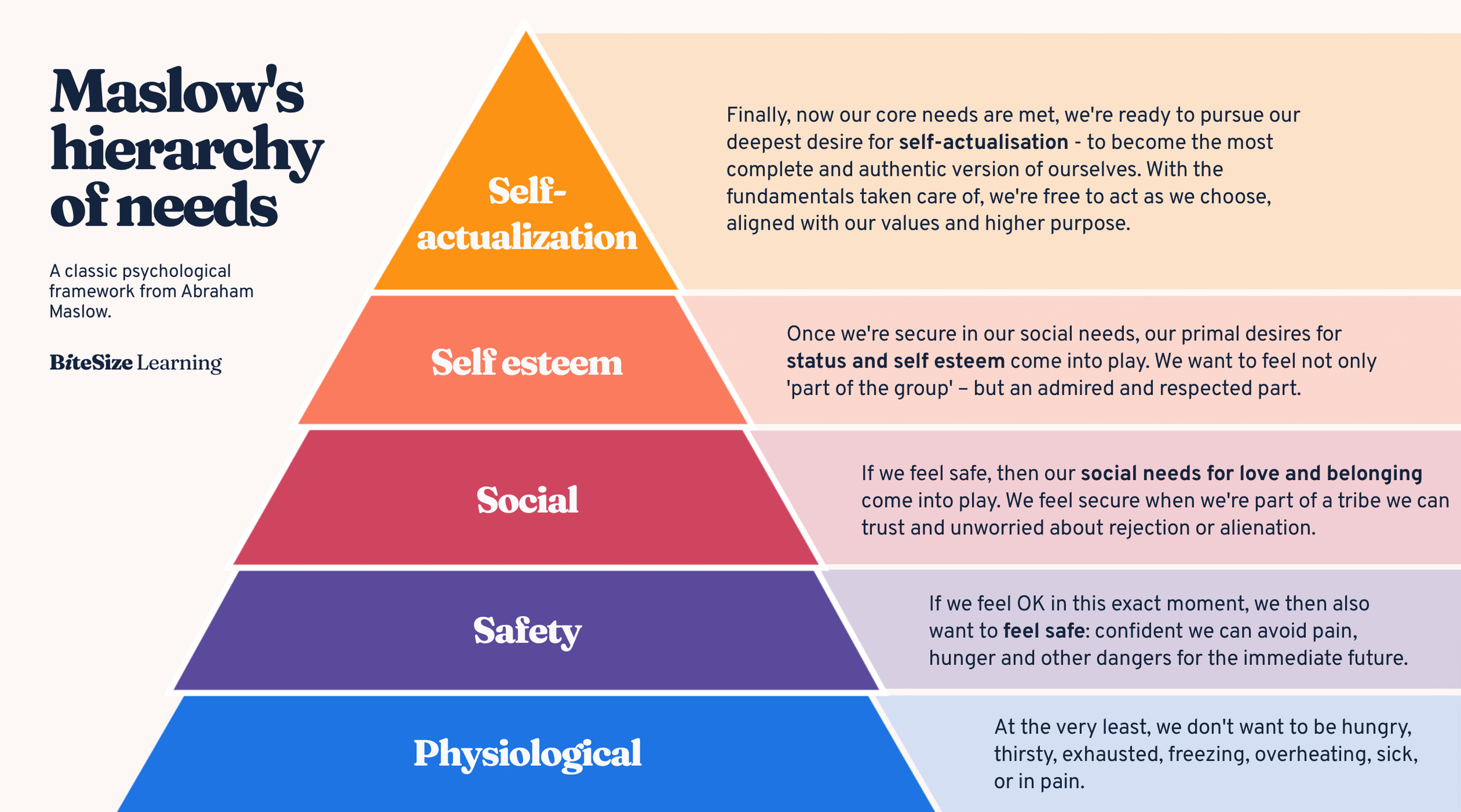
Maslow’s Hierarchy of Needs is an article of faith for those in the helping professions. The TLDR version of Maslow’s framework is that humans have an innate drive to reach their full potential, which is called “Self-Actualization.” Each layer in the Pyramid is a set of needs that humans will try to meet. Once the needs on a layer are met, they will innately seek out the needs on the subsequent layer.
In a previous post, I shared one basic set of reasons why I disagree with Maslow’s Hierarchy. My point was that people are remarkably resilient and often flourish in adversity, despite lacking resources to meet their basic needs.
The post isn’t perfect. But I hope that, at the very least, it gives purchasers of a life philosophy reason to do a little more research before pulling the trigger and buying Maslow’s nifty little triangle.
More Critiques of Maslow
In an interview with Chris Williams, Luise Perry alerted me to something Mary Harrington had said about marriage and Maslow’s Pyramid. That interview helped me uncover a whole other line of arguments against Maslow’s Pyramid and sent me down several rabbit holes, which I will now share with you.
According to Perry, Harrington argues that people of lower economic means tend to be more satisfied with their marriages, because they ask less of the institution. If your partner is faithful, helps a little with the kids, and maintains a modest level of personal hygiene—then, all is good.
The wealthy, on the other hand, tend to place very high expectations on a marriage. They believe their partner must not just satisfy their basic needs; they need to satisfy all their deepest desires, as well. ‘Cause if they don’t, there are several other viable options available at the club, the gym, or the charity gala.
If Harrington is right, then Maslow’s Pyramid fails as a predictive framework.
I’m suffocating in this marriage
Harrington’s comments fit well with something Psychologists call the Suffocation Model of Marriage. They note that as material wealth has grown over the centuries, people’s expectations for the institution of marriage have grown, as well.
1776–1850. Marriages were understood to meet basic physiological and safety needs. These needs are at the bottom of Maslow’s Pyramid.
1850–1965. These years saw the rise of companionate marriages, characterized by love and belonging. These needs are midway up The Pyramid.
1965–present. The modern view of marriage emphasizes the top of Maslow’s pyramid: self-actualization and authenticity.
The problem, say psychologists, is that the air at the top of the pyramid is thin. Modern people demand that marriage satisfy high-level needs for personal fulfillment. This increases the pressure on the relationship, leading to higher divorce rates when those needs aren’t met. Moving up the pyramid doesn’t mean you are moving closer to reaching your full potential; it just means you are gaining a longer checklist of potential excuses to be unsatisfied with your marriage.
In contrast to what Maslow predicts, the Suffocation Model of Marriage suggests that having our needs met doesn’t make us content; it can actually make us more demanding.
The danger of ease
Having it all can actually be harmful. For example, bears in captivity are living in the lap of luxury. They have all their nutritional needs provided for them, and they don’t have to forage for their meals like, you know, bears. But, bears do not become relaxed and content when they are well fed, nor do they begin to scale Maslow’s Hierarchy of Needs. Instead, they develop behavioral tics and physical problems. It turns out they need some stress and resistance in their lives to remain healthy.
Bears are not alone in this need to be challenged. Babies need to be placed on the floor to struggle with keeping their heads up, or they don’t develop properly. Sports teams need worthy competition to push them to their full potential. Young actors, artists, and musicians need a hunger for fame that drives them to experiment and take risks. Muscles require stress to prevent atrophy. The heart needs exercise; otherwise, it is at risk of an attack. Necessity isn’t only the mother of invention, it’s the mother of health and well-being, too.
And don’t forget about the Hedonic Treadmill
A comedian once gave an illustration that perfectly illustrates the meaning of what psychologists call the hedonic treadmill. He observed how wonderful it felt the first time he was on a flight with free wifi. The passenger next to him was thrilled, too, and began clicking things on his phone—perhaps he was playing a video game, doomscrolling, or texting with his sweetheart. But whatever he was doing, he was enjoying himself. That’s called hedonic pleasure.
Then a funny thing happened. Some kind of technical snag occurred with the wifi, and the passenger’s moment of joy came to a crashing halt. He slammed down his device on the table in front of him and declared, “This is bulls***!
The comedian wryly observed, “This guy was infuriated that he was denied something that didn’t even exist last week.” That’s the hedonic treadmill. We’re never content because each new pleasure is only enjoyable for a moment. It quickly loses its luster and becomes our new baseline.
What’s worse than a (hedonic) treadmill?
Although psychologists are correct about the hedonic treadmill, the situation is worse than they imagine. Not only do we get quickly accustomed to new pleasures, but each time we feed a desire, it grows and becomes more demanding. Something inside us is like that plant in the movie, “Little Shop of Horrors.” It screams, “FEED ME, Seymour! Feed ME!”
Unless we are careful, our desires can master us, driving us to humiliate ourselves for just a little more of what we crave. Addicts know this. One drink is too many, and 1000 is never enough. Bob Dylan knew about it, too. He wrote about it in the song, She Belongs to Me. In it, he describes a man who believed he could turn a woman into a conquest by impressing her with lavish gifts. Instead of winning her heart, he loses his mind, becoming her pathetic sycophant.
You will start out standing
Proud to steal her anything she sees
But you will wind up peeking through her keyhole
Down upon your knees
Human motivation: The Bible vs Maslow
The Bible has a better grasp on human motivation than Maslow. It shows what humans are really like. King Solomon had unimaginable wealth and became listless and depressed. He famously said, “It’s all meaningless, meaningless!”
While in the desert, the Israelites had enough manna for all their nutritional needs and decided they’d rather go back into slavery than choke down another bite. The rich fool in Luke 12 had an abundant harvest, but instead of pursuing higher goals, he ignored God and the needs of his fellow human beings and built larger barns to keep his wealth for himself.
The Sons of Zebede were in Jesus’ inner circle, but couldn’t be content until they knew Jesus would give them seats at his right and left hand in the Kingdom. Adam and Eve thought the Garden of Eden was nice and all, but decided they’d rather die than be denied a bite of that forbidden fruit. And King David had wealth and wives a-plenty, but he would just kill to have his neighbor’s wife, too.
Just look at what the Lord said to King David. Does it sound like having it all made David pursue self-actualization? Or self-indulgence?
“I anointed you king over Israel, and I delivered you from the hand of Saul. 8 I gave your master’s house to you, and your master’s wives into your arms. I gave you all Israel and Judah. And if all this had been too little, I would have given you even more. 9 Why did you despise the word of the Lord by doing what is evil in his eyes? You struck down Uriah the Hittite with the sword and took his wife to be your own.”
You can hear the frustration in his voice. When will it be enough, David? When will it ever be enough? Maslow would have predicted that, after all God had given to David, David would move on to actualizing rather than what he actually did. And what he actually did was to pursue the one thing he didn’t have, as if everything he had was nothing. As Shakespeare might have said, instead of satisfying him, all David’s more-having was like a sauce to make him hunger more.
The truth is, humans have more than one innate drive. They have a desire to do good and a desire to do evil, a drive to flourish and a drive to self-destruct. If not tamed, even our positive desires can ruin us. The drive to support our family can drive us to cut corners at work. A musician’s desire to share his music with the world puts him at odds with his bandmates. Rick’s love for Ilsa competes with the goal of defeating the Nazis in the movie Casablanca. People live their entire lives chasing one thing after another and end up filled with regrets.
We don’t ascend Maslow’s Pyramid; we war with ourselves and everybody else. Cash, Porter Wagoner, and Dylan can’t be wrong: Ain't one man in ten with a satisfied mind.
‘
Great post. Having been all over the place in my life, I get why people buy it. And it's true that during the times when I was missing meals and worrying about sleeping in my car, a lack of creative fulfillment was much lower on my priority list. It was still there. I still needed to draw even when I was hungry.
I think this one is a case of projection. In the same way that a lot of narcissists (*cough* Sam Harris) overreacted to Covid because the idea that the world might have to keep spinning without them was beyond what they could tolerate, a lot of people imagine that everyone else reacts the way they do.